Financial Forecasting: How to Plan for Long-Term Growth


In today’s fast-paced business environment, making smart choices is key for long-term growth. Financial forecasting helps companies see what’s coming. It lets them get ready for challenges and grab new chances.
Good business planning needs solid financial forecasting. It helps businesses use their resources well and grow steadily. Knowing how to forecast finances is vital. It helps companies deal with market ups and downs and make smart plans.
Key Takeaways
- Financial forecasting is crucial for long-term business success.
- Accurate forecasting enables informed decision-making.
- Businesses can better allocate resources with effective financial forecasting.
- Financial forecasting drives sustainable growth.
- Understanding financial forecasting is key to navigating market complexities.
The Fundamentals of Financial Forecasting
In today’s fast-paced business world, financial forecasting is key. It helps companies make smart choices. It’s more than just guessing future money matters; it’s a detailed guide for reaching goals.
Defining Financial Forecasting in Today’s Business Environment
Financial forecasting looks at past data and market trends to guess a company’s future money situation. It helps businesses see challenges and chances ahead. To do it well, you need to know your business inside out and the market too.
The Critical Role of Forecasting in Growth Planning
Forecasting is crucial for planning growth. It lets companies set achievable goals and use resources wisely. By knowing what’s coming, businesses can handle growth, manage risks, and grab new chances. A good forecast is like a map to success.
How Forecasting Differs from Budgeting
Forecasting and budgeting are often mixed up, but they’re different. Budgeting is about setting money goals and planning how to reach them, usually yearly. Forecasting is about predicting money trends as they change, based on new data and market shifts. Here’s a simple table to show the difference:
| Aspect | Forecasting | Budgeting |
|---|---|---|
| Purpose | Predict future financial outcomes | Set financial targets and allocate resources |
| Frequency | Ongoing, as new data becomes available | Typically annual |
| Flexibility | Adjusts to changes in market conditions | Fixed at the beginning of the period |
Knowing the basics of financial forecasting is vital for growth. It helps businesses tackle market challenges and reach their goals.
Key Components of Effective Financial Forecasts
To make a detailed financial forecast, you need to know a few key things. It’s crucial for businesses to make smart choices and grow.
Revenue Projections and Growth Modeling
Revenue projections are key in financial forecasting. Companies must look at past data, market trends, and customer habits. Growth modeling uses this info to guess future revenue, considering things like seasonality and competition.
Expense Forecasting and Cost Control
Forecasting expenses is just as important. It helps businesses plan and manage their costs. By finding fixed and variable costs, and looking for ways to cut costs, companies can boost their profits.
Cash Flow Analysis and Management
Cash flow analysis is vital for a business’s liquidity. It forecasts cash coming in and going out, manages accounts, and keeps a cash reserve. Cash flow management helps avoid financial trouble and seize growth chances.
Capital Requirements and Investment Planning
Figuring out capital needs is key for funding growth. This means looking at the need for loans or investments and making an investment plan. Companies must find the right balance in their finances to grow safely.
By focusing on these areas, businesses can make solid financial forecasts. These forecasts help guide strategic decisions and lead to success. Using financial modeling and forecasting tools can make forecasts even more reliable.
Financial Forecasting Methods for Growth-Oriented Businesses
In today’s fast-paced business world, picking the right financial forecasting method is key for growth. Businesses must deal with changing market trends, consumer habits, and economic shifts. Good financial forecasting helps companies spot challenges, seize opportunities, and make smart strategic choices.

Quantitative Forecasting Techniques
Quantitative forecasting uses past data and statistical models to predict future finances. It’s great for businesses with a steady track record and clear trends.
Time Series Analysis
Time series analysis looks at past data to find patterns and trends for the future. It works well for businesses with regular sales cycles or seasonal changes.
Regression Analysis
Regression analysis uses stats to see how different factors affect finances. It helps businesses find out what drives their revenue and costs.
Qualitative Forecasting Approaches
Qualitative forecasting is key for businesses in fast-changing markets or with little historical data. It uses expert opinions and market insights.
Expert Opinions and Delphi Method
The Delphi method collects opinions from experts to predict future trends. It’s good for new businesses or those exploring new markets.
Market Research Integration
Adding market research to financial forecasting gives insights into consumer behavior, competitor moves, and new trends. This helps businesses update their financial plans.
Choosing the Right Method for Your Business Size
The right forecasting method depends on your business size and complexity. Smaller businesses might use simpler, qualitative methods. Larger enterprises might need more complex quantitative models. It’s important to pick a method that fits your business needs and resources.
By using these financial forecasting methods, growth-oriented businesses can tackle expansion challenges and reach their goals.
Building Your First Financial Forecast Step-by-Step
Creating a financial forecast is a key step for businesses to predict their future finances. It involves several important steps. These steps help companies make strategic decisions and grow in the long run.
Gathering and Analyzing Historical Financial Data
The first step is to collect and analyze past financial data. This includes looking at income statements, balance sheets, and cash flow statements. Historical data helps make accurate predictions about future finances.
Identifying Key Growth Drivers and Assumptions
Next, businesses need to find out what will drive their growth. This includes market trends, customer demand, and economic conditions. Getting these assumptions right is crucial for a reliable forecast.
Creating Baseline Projections
With the data and growth drivers in place, businesses can make baseline projections. They use financial models to forecast revenue, expenses, and cash flow. These projections are a starting point for further analysis.
Developing Best-Case, Worst-Case, and Most Likely Scenarios
To handle uncertainty, businesses should plan for different scenarios. This includes best-case, worst-case, and most likely scenarios. Scenario planning helps manage risk and seize opportunities.
| Scenario | Description | Potential Impact |
|---|---|---|
| Best-Case | Optimistic growth projections | Higher revenue, increased market share |
| Worst-Case | Pessimistic growth projections | Lower revenue, reduced market share |
| Most Likely | Realistic growth projections | Stable revenue, maintained market share |
Validating Your Forecast with Stakeholders
Finally, businesses should check their forecast with stakeholders. This includes investors, lenders, and management teams. Getting stakeholder approval is key to securing funding and growth.
Essential Tools and Technologies for Financial Forecasting
Companies are now using advanced tools for financial forecasting to keep up with the economy’s changes. The right technology can greatly improve the accuracy of financial predictions.
Spreadsheet-Based Forecasting Solutions
Many businesses start with tools like Microsoft Excel for forecasting. While they’re familiar, they can get too complicated as the business grows. It’s key to consider the benefits of knowing how to use them against their limits in growth and teamwork.
Specialized Financial Forecasting Software
Specialized software offers advanced features for financial forecasting. It includes automated data integration, scenario planning, and advanced analytics. Companies like Anaplan and Adaptive Insights provide strong solutions for complex forecasting needs.
Cloud-Based Forecasting Platforms
Cloud-based platforms have changed financial forecasting by making it easier to work together and grow. They let teams collaborate smoothly, no matter where they are. A financial expert said, “Cloud-based forecasting has changed how we quickly respond to market changes.”
“The future of financial forecasting lies in the integration of AI and machine learning, enabling businesses to predict trends with greater accuracy.”
AI and Machine Learning Applications
AI and machine learning are being used more to improve financial forecasting. They can look at lots of data to find patterns and predict trends.
Popular Tools Used by Brazilian Businesses
In Brazil, businesses are using a variety of forecasting tools. They choose based on their specific needs and the industry they’re in.
Overcoming Common Financial Forecasting Challenges
Effective financial forecasting faces several hurdles, from data quality to market changes. Businesses must tackle these to make accurate forecasts. These forecasts help drive growth and guide strategic decisions.
Dealing with Limited or Inconsistent Data
One big challenge is dealing with limited or inconsistent data. Companies can use strong data collection systems. They can also apply statistical methods to fill data gaps.
Managing Market Uncertainties and Volatility
Another challenge is managing market uncertainties and volatility. Businesses can use scenario planning and sensitivity analysis. This helps prepare for different outcomes.
Avoiding Cognitive Biases in Forecast Creation
Avoiding cognitive biases is key for accurate forecasts. This can be done by involving diverse stakeholders. Using objective, data-driven methods is also important.
Adapting Forecasts to Rapid Market Changes
Adapting forecasts to market changes requires constant monitoring. Businesses need to adjust forecasts based on new data. Regular review cycles and real-time data use are essential.
Addressing Brazil-Specific Forecasting Challenges
Brazilian businesses face unique challenges like economic fluctuations and regulatory changes. To overcome these, staying informed about local conditions is crucial. Incorporating flexibility into forecasting models is also important.
By tackling these common challenges, Brazilian businesses can improve forecast accuracy. This leads to better decision-making for growth and success.
Integrating Financial Forecasting into Strategic Business Planning
To grow sustainably, businesses need to blend financial forecasting into their plans. This helps them make smart choices, use resources well, and handle market changes.
Aligning Forecasts with Strategic Objectives
It’s key to match financial forecasts with business goals. This means spotting what drives growth, knowing market trends, and building models that show the company’s direction.
Using Forecasts to Inform Critical Business Decisions
Forecasts are vital for making big decisions like where to invest, how to use resources, and managing risks. They help predict problems, spot chances, and guide decisions based on data.
Communicating Forecast Insights to Different Stakeholders
Telling stakeholders about forecast insights is crucial. This includes investors, management, and employees. Clear talk builds trust and helps everyone work together.
Creating a Continuous Forecasting and Planning Cycle
Having a cycle for forecasting and planning keeps forecasts up-to-date. It means always checking financial performance, market changes, and goals. This keeps plans on track.
| Strategic Planning Component | Financial Forecasting Role | Business Benefit |
|---|---|---|
| Resource Allocation | Predicting future financial needs | Efficient use of resources |
| Risk Management | Identifying potential financial risks | Proactive risk mitigation |
| Investment Decisions | Evaluating investment opportunities | Informed investment choices |
By mixing financial forecasting into planning, companies can grow and succeed over time.
Financial Forecasting in the Brazilian Business Context
In Brazil, making good financial forecasts is essential. The country’s economy, rules, and market trends all affect these forecasts.
Navigating Brazil’s Economic Environment and Regulations
Brazil’s economy sees ups and downs in currency, inflation, and rules. Businesses need to keep up with these changes. Understanding how economic policies affect business is key for smart decisions.
Accounting for Currency Fluctuations and Inflation
Currency changes and inflation are big issues in Brazil. Companies must find ways to deal with these risks. This includes hedging against currency changes and adjusting prices for inflation.
- Watch exchange rates closely
- Use financial tools to manage currency risks
- Change prices to keep profits up
Tax Considerations in Brazilian Financial Planning
Brazil’s taxes are complex, with many rules that affect planning. Businesses must think about these when making forecasts. This helps them follow the law and save on taxes.
Industry-Specific Forecasting Approaches in Brazil
Each industry in Brazil has its own challenges. For example, farming deals with seasons, and tech faces fast changes. So, forecasts must be made for each industry.
Success Stories: Brazilian Companies Excelling at Financial Forecasting
Many Brazilian companies are great at forecasting. Their success shows what’s possible with good planning. These stories can help other businesses in Brazil.
Measuring and Improving Forecast Accuracy
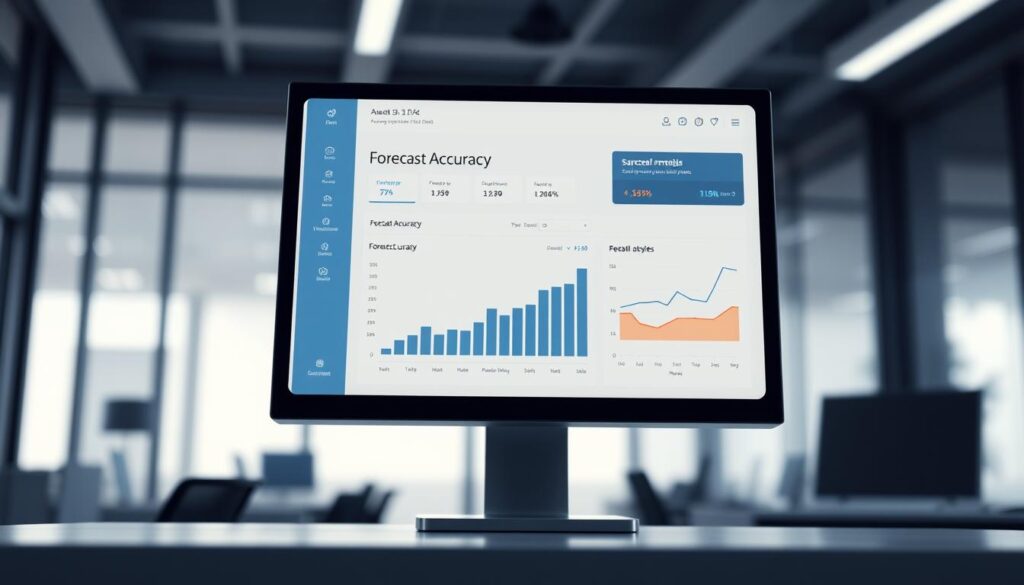
Measuring forecast accuracy is key to better financial forecasting. Accurate forecasts help businesses make smart decisions. They also help in using resources well and dealing with market changes.
Key Performance Indicators for Forecast Evaluation
Businesses use KPIs like Mean Absolute Error (MAE) and Mean Absolute Percentage Error (MAPE) to check forecast accuracy. These metrics show how close forecasts are to real values.
| KPI | Description | Use Case |
|---|---|---|
| MAE | Average difference between forecasted and actual values | Evaluating overall forecast accuracy |
| MAPE | Average percentage difference between forecasted and actual values | Comparing forecast accuracy across different scales |
Variance Analysis Techniques
Variance analysis looks at the differences between forecasted and actual values. It helps find out why there are differences. This helps in making better forecasts in the future.
Learning from Forecast Deviations
By studying forecast deviations, businesses can spot patterns and areas to improve. They can then update their assumptions, data, and forecasting methods.
“The key to successful forecasting is not just predicting the future but understanding the present.”
Implementing a Continuous Improvement Process
A continuous improvement process makes forecasting better over time. It involves regularly checking forecasting methods, adding new data, and adjusting to market changes.
Benchmarking Against Industry Standards
Comparing forecast accuracy to industry standards shows how a company is doing compared to others. This can point out areas to get better and what to learn from others.
By focusing on these areas, businesses can greatly improve their forecast accuracy. This leads to better decision-making and planning. Good financial forecasting is crucial for business growth strategies. It helps companies deal with uncertainty and grab opportunities.
Conclusion: Transforming Financial Forecasting into Sustainable Growth
Effective financial forecasting is key to lasting business growth. It helps you make smart decisions for long-term success. By understanding and using financial forecasting in your strategy, you can achieve your goals.
Financial forecasting is more than just guessing future earnings and costs. It’s about a detailed plan that includes revenue, expenses, cash flow, and capital needs. This approach helps businesses build a strong financial plan that supports growth.
In today’s fast business world, companies that forecast well can handle market changes and find new chances. Using the right forecasting methods, tools, and tech can make forecasts more accurate. This leads to steady growth.
Keep working on your financial forecasting skills. It’s an ongoing task that needs regular updates. By following best practices and using what you learn, you can improve your business planning. This will help you reach your growth goals.
FAQ
What is financial forecasting, and why is it important for business growth?
Financial forecasting is about guessing future money matters based on past data and trends. It’s key for growth as it helps make smart choices, use resources well, and get ready for hurdles.
How often should a business update its financial forecasts?
Update frequency varies by business size, type, and market changes. Usually, check and update forecasts every quarter or with big market or operation changes.
What are the key components of a comprehensive financial forecast?
A full forecast includes income guesses, cost predictions, cash flow checks, and funding needs. These parts help see the financial health, spot improvement spots, and guide big decisions.
How can businesses improve the accuracy of their financial forecasts?
To boost forecast accuracy, use past data, market studies, and industry standards. Also, keep improving by regularly checking and tweaking forecasting methods to match changing markets.
What role does financial forecasting play in strategic business planning?
Forecasting is vital for planning as it shows future money outlooks. This lets businesses align forecasts with goals, make smart choices, and grow.
How can businesses in Brazil navigate the local economic environment when creating financial forecasts?
Brazilian businesses can stay on top of local trends, currency shifts, and rule changes. Also, think about specific forecasting methods and taxes for more precise forecasts.
What tools and technologies are available for financial forecasting?
Many tools and techs help with forecasting, like spreadsheets, special software, cloud platforms, and AI. Pick what fits your needs and size best.
How can businesses measure the effectiveness of their financial forecasting processes?
Track key signs like forecast accuracy, variance, and industry comparisons. This shows where to get better and fine-tunes forecasting.